
Growth is the goal for every founder. However, many startups struggle when their user base suddenly spikes. Scaling your tech stack involves more than just buying bigger servers. It requires a rethink of how your code and data interact. This guide helps you navigate that transition without breaking your budget. Scaling Your Tech Stack: What Startups Should Know involves planning for success before the traffic arrives. If you wait until your site crashes, you are already too late. Proactive planning keeps your system stable while your business expands. If you want a related deep dive, read How to Choose the Best Tech Stack for Your Startup in 2024.
Choose Scalable Technologies from the Start
Startups often pick tools based on the speed of development. This approach works for a minimum viable product but fails at scale. You must choose technologies that support high concurrency from the beginning. Many startups miss this early decision and pay for it later. Languages like Node.js or Go are great for handling many connections at once. PostgreSQL is a reliable choice for relational data because it handles complex queries well even as the dataset grows. You should also consider how your frontend components will be reused. A modular approach allows your team to build faster as the application grows in complexity. Scaling Your Tech Stack: What Startups Should Know starts with these foundational choices. Picking a framework with a small community can lead to hiring problems later. Stick to proven tools with large ecosystems. This ensures you can find developers and plugins when you need to move fast. It is better to have a slightly slower initial launch than a product that cannot grow past its first thousand users. For a practical follow-up, see How to Choose the Right Tech Stack for Your MVP Development.
- Node.js for high performance backend logic
- PostgreSQL for reliable and structured data storage
- React or Vue for modular frontend architecture
- Go for high concurrency and system efficiency
- Cloud native services for easy infrastructure growth
The Shift to Horizontal Scaling
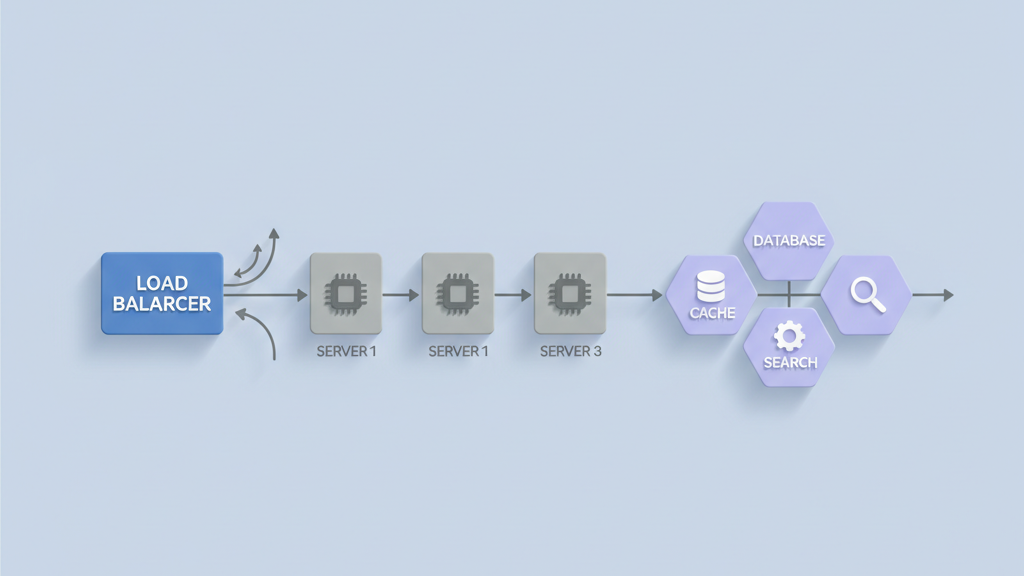
Vertical scaling means adding more power to one server. You add more RAM or a faster CPU to your existing machine. This has a hard limit. Eventually, you cannot buy a bigger server. Horizontal scaling means adding more servers to share the load. This is a better path for long term growth. It allows you to handle millions of users by spreading them across a fleet of machines. You will need a load balancer to direct traffic. This setup ensures that if one server fails, the others keep running. It provides high availability which is critical for retaining users. Many founders ignore this until a single server crash takes their whole business offline. Horizontal scaling also makes it easier to update your software. You can take one machine down for maintenance while the others remain active. This eliminates downtime during deployments. It is a more flexible and cost effective way to manage a growing user base. Startups should aim for this architecture as soon as they see consistent growth in traffic.
Optimizing Database Performance
Your database is usually the first thing to break. As you write more data, your queries get slower. You can fix this by introducing caching layers. Redis is the industry standard for this task. It keeps frequently used data in memory. This reduces the strain on your primary database significantly. You should also look into read replicas. This allows you to send read traffic to one server and write traffic to another. This separation prevents slow reports or searches from blocking user signups or purchases. Scaling Your Tech Stack: What Startups Should Know requires a deep look at data bottlenecks. If your database is still slow, you might need to look at sharding. This involves splitting your data into smaller pieces across multiple databases. It is a complex process but necessary for massive scale. Always index your tables properly before trying these advanced methods. A simple missing index is often the cause of slow performance. Regular maintenance like vacuuming your database can also keep things running smoothly.
- Implement Redis for high speed data caching
- Use read replicas to distribute query traffic
- Set up database sharding for very large datasets
- Monitor slow query logs to find bottlenecks
- Ensure proper indexing on all frequently searched fields
Automation and Modern DevOps
Manual deployments are a major risk for any growing company. They lead to human error and unexpected downtime. Automated pipelines are the modern solution. Continuous integration and deployment tools allow your team to push code with confidence. Every change is tested before it goes live. This speed is a competitive advantage. It allows you to fix bugs in minutes instead of hours. Infrastructure as code is another big win. It lets you define your servers in a text file. You can recreate your entire environment with one command if something goes wrong. This consistency is vital when you are managing dozens of servers. Many startups find that automation reduces the workload on their engineering team. It allows developers to focus on building features instead of fixing broken servers. A well automated stack is much easier to scale because adding a new server is just a matter of running a script. It also makes the onboarding process for new engineers much smoother. If you need implementation support, explore FlutterFlow development.
Monitoring for Proactive Growth
You cannot fix what you cannot see. Many startups only look at simple uptime metrics. You need to look deeper into latency and error rates. Monitoring tools give you a clear dashboard of your system health. You should set up alerts for when resource usage hits a certain threshold. This gives your team time to react before the site actually crashes. Real time logs are also helpful for debugging production issues. They tell you exactly what happened during a failure. Many companies wait for a customer to complain before they realize there is a problem. This is a mistake. Proactive monitoring helps you find issues before the user even notices. It also helps you identify patterns in traffic. You can see when your peak hours are and scale your resources accordingly. This data driven approach saves money by preventing over provisioning. A related guide worth reviewing is How To Set Product Metrics And KPIs For Startups That Scale.
- Datadog for comprehensive system visibility
- Prometheus for detailed metric collection
- Grafana for creating visual health dashboards
- Slack or PagerDuty for critical system alerts
- ELK stack for centralized log management
Managing Costs and Technical Debt
Scaling is expensive. Cloud bills can spiral out of control if you are not careful. You must balance performance with your budget. Technical debt is another hidden cost. Shortcuts taken during the initial development phase will slow you down later. It is wise to schedule regular refactoring sessions. This keeps the codebase clean and manageable. A lean tech stack is often easier to scale than a bloated one. Focus on simplicity where possible. Do not add new tools just because they are trendy. Every new tool adds complexity and another point of failure. It is often better to master a few reliable tools than to have a dozen poorly managed ones. Regular audits of your cloud spending can reveal unused resources that are costing you money. Optimization is just as important as expansion. A startup that scales efficiently will outlast one that wastes its capital on unoptimized infrastructure. Teams moving from strategy to execution can review Software maintenance and scaling.